Tuesday, March 31, 2015

The Role of Agribusiness

The role of agribusiness in the food system is perhaps one of the most important relationships that there is on the planet. Agribusiness is a broad term that combines all those who play a part in the production and sale of food and drink products. Everything from the seed producers to the retail outlets and restaurants that sell the final product falls within the criteria of “agribusiness”. Companies in the agribusiness chain include globally prominent multi-billion dollar companies such as Monsanto, Archer Daniels Midland, PepsiCo, and Nestle as well as tens of thousands of much smaller businesses. These companies make up the control agribusiness and play a leading role in our world food system.

Agribusiness has transformed the planet in ways that are both criticized and praised. For instance, Monsanto, a multi-billion dollar seed and chemical company has introduced products and technologies that have significantly changed the landscape of agriculture. In 2009 Monsanto was ranked as the company of the year by Forbes magazine but since then the world's perception of them has reached rock bottom due to their GM products that are banned in the EU for health concerns and for their chemical products that are polluting our planet.
The days of agriculture being the largest sector of employment for Americans are long gone, as are the days of small, self-sustaining family farming practices. Food systems, now mostly managed by global corporations are largely out of sight, out of mind for the average consumer in developed areas of the world. With agribusiness has come chemicals in our foods, pollution, water crisis, obesity, and a disruption to the natural processes of the world among other things. There is no question that we could not be where we are as a planet without agribusiness, it is both good and bad, unwanted but completely necessary. It is biofuels, diet and health, animal welfare, food insecurity, and so much more. As the world becomes more reliant on agribusiness the number of those who are chronically malnourished in developed countries has dropped from 34% in the 1970s to just 15% now in the 2000s. We have also seen third world countries develop their economies, a decrease in global poverty, and a better sense of food security than ever before. As the world population grows so will the importance of agribusiness as it attempts to improve supply chains, crop yields, education, and infrastructure so it can continue to feed the world.

Monday, March 23, 2015

Animal Welfare

As many of us know there is plenty of controversy when it comes to meat these days. Film after film and article after article condemns feed systems, battery pens and all other means of getting affordable meat onto our tables. So is the farmer, the meat eater, all-in-all just cruel, uncaring to the life of an animal, or desensitized to it. There may be truth there, but there may also be truth in the part that most of us today are so detached from our meat that we don't know what it looks like to kill an animal without it looking cruel, or thinking all those "nasty" bits and pieces that the rest of the world consumes are "gross". No matter what it is, it is certainly a reality that growing populations, factory farming, and creating an economy of scale have led themselves to system that is in all reality not ideal,  and in many ways is cruel.

So with all the controversy it lends one to question: What are the rules and regulations on meat production here in the United States? There are a few labels that are regulated as by the US government. The most commonly seen is the address the use of antibiotics in poultry and pork. Most packages of these meats will have the ** after a statement about being antibiotic free- with the small print disclaimer that federal regulations prohibit the use, thought this is not in all senses directly related to the welfare issue. Cage free and free range directly address the issue of pen systems, and things like grass-fed regulations address feed systems. But to be perfectly honest there is little else in place that is a directly a regulation on meat producers. Most other labels and system regulations are self imposed, third party regulations, created as way to meet the consumer demand for better quality, well treated animal based products.

These regulations offer approval stamps, as well as ratings like the 5 step program put in place by Whole Foods market (pictured below), so that concerned individuals who still wish to eat meat but would otherwise not based on the general nature of large scale meat product have an option. Farms and markets are willing to meet the demand and at least for now you have both systems working next to each other, but there is ever more pressure that consumer demand will potentially cause a more EU like approach to animal regulations.


So how does the European Union regulate?
The European Convention for the Protection of Animals kept for Farming Purposes reflects what are know as the "Five Freedoms"
  • Freedom from hunger and thirst - access to fresh water and a diet for full health and vigour,
  • Freedom from discomfort - an appropriate environment with shelter and comfortable rest area,
  • Freedom from pain, injury and disease - prevention or rapid treatment,
  • Freedom to express normal behaviour - adequate space and facilities, company of the animal's own kind,
  • Freedom from fear and distress - conditions and treatment which avoid mental sufferings.
These minimum standards ensure that even farms just meeting minimum standards that those protect the quality of life of animals in the agricultural system. 

Interestingly enough in France is the case of Foie Gras. Gavage, which is the practice of force feeding corn to ducks and geese to fatten their livers for the product is widely seen by many across the Western world as a cruel practice (look up images on your own as you wish). It was even until recently illegal in the state of California. However gavage is written into law as required for foie gras production. This however is now coming under the kind of scrutiny that the rest of the meat industry has in the past. We'll have to wait and see what, if anything changed in the future.


Wednesday, March 11, 2015

Food Security and Global Hunger


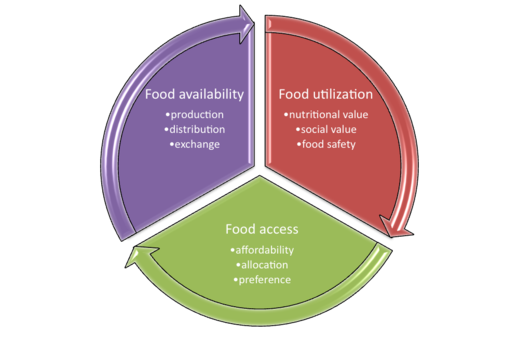
Feeding the world and the world consistently having access to safe, nutritious food is a topic that has been discussed for decades if not centuries and continues to be a common topic as the world’s population continues to increase. Food security is defined as “when all people at all times have access to sufficient, safe, nutritious food to maintain a healthy and active life” according to the World Health Summit of 1996.  It is based on three pillars availability, access, and use.


http://medanth.wikispaces.com/file/view/Food_SecurityChart.png/224324454/520x342/Food_SecurityChart.png
The first pillar, food availability, consists of availability to a sufficient quantity of food on a consistent basis. The second pillar, food access, is defined as having adequate resources to nutritious foods that meet dietary standards. The last pillar, food use, is defined as the appropriate use of food and clean water based on dietary needs and nutrition, all according to the World Health Organization.

Food insecurity varies by location, economic status, agricultural production and more. In each location of the world the level of food insecurity is different, in fact, there is the Global Food Security Index which ranks each country based on their food security scores. The United States is ranked as number one with an overall score of 89.3, an affordability score of 94.8, availability score of 85.5, and quality and safety score of 85.7.

Despite the United States ranking number one among all countries and having fairly high scores, there is still a decent amount of Americans that experience food insecurity. In 2012, 14.5% of American households experienced food insecurity, meaning that the household was not able to feed all it members due to inadequate resources. This statistic, unfortunately, has been “relatively unchanged” since 2008 according to the USDA. Also in 2012, 5.7% of American households, approximately 7 million households, experienced very low food security which means that the household had very limited resources which created a lower intake of food and changes in eating patterns.
 
 
Video from Feeding America regarding results from their Hunger in America 2014 report
 

Since this class compares agriculture and food systems of the United States and France, when comparing food security, France is ranked slightly lower at number ten. France’s overall score is 83.7, the affordability score is 85.9, the availability score is 79.7, and the quality and safety score is 87.6. The overall score of France is only slightly lower than the U.S.’s but the quality and safety score of France is slightly higher. In both the U.S. and France the availability score is the lowest when comparing all scores for each country.

As the world’s population continues to grow there will be more and more people that will need safe, nutritious food. One concern that many people have raised is that it will not be possible to produce enough food to support the population based on the food production practices of today. Another concern is that the amount of food needed is being made now but there is no means of getting the food to those who need it. It is evident that food security and global hunger will unfortunately be an issue for years to come unless some more action and problem solving is taken.

Wednesday, February 25, 2015

Why Americans Should Take Notes on the French Diet

More than 1/3 or 34.9% of the American population is considered "obese" (A person is considered obese if they have a BMI of over 30) in 2014 according to the CDC.  This is shocking statistic. It tends to be correlated with Americans consuming foods that contain too much sodium and too many calories from solid fats, along with little exercise. The Dietary Guidelines for Americans suggests that Americans need to increase their nutrient consumption and limit their intake on sodium, solid fats, added sugars, and refined grains, and increase their consumption of vegetables, fruits, whole grains, fat-free or low-fat milk, seafood, lean meats, eggs, beans, peas, nuts, and seeds. With efforts like this, as well as banning sodas and junk food from schools and more clarity on food labeling - there has been evidence of obesity stabilization recently in the United States! While the obesity rate is at its highest it has ever been, continual efforts are at least stopping it from reaching a greater percentage of the American population.


More than 1/3 or 34.9% of the American population is considered "obese" (A person is considered obese if they have a BMI of over 30) in 2014 according to the CDC.  This is shocking statistic. It tends to be correlated with Americans consuming foods that contain too much sodium and too many calories from solid fats, along with little exercise. The Dietary Guidelines for Americans suggests that Americans need to increase their nutrient consumption and limit their intake on sodium, solid fats, added sugars, and refined grains, and increase their consumption of vegetables, fruits, whole grains, fat-free or low-fat milk, seafood, lean meats, eggs, beans, peas, nuts, and seeds. With efforts like this, as well as banning sodas and junk food from schools and more clarity on food labeling - there has been evidence of obesity stabilization recently in the United States! While the obesity rate is at its highest it has ever been, continual efforts are at least stopping it from reaching a greater percentage of the American population.


In comparison, French people are considered the "slimmest" Europeans, followed closely by the Swiss and the Italians. But in France the percent obesity doubled from 5.5% in 1995 to 11% in 2004, almost ten years later. Why then, while the obesity in France and the United States has both increased, do French people tend to have less health issues than Americans? Today France is considered the least obese country in Europe. Two observations can be made from these facts - Although the French obesity rate is increasing, it is also increasing in all countries with the increase in fast food, frozen food, and availability to food. So, while the French rate of obesity is increasing, France has remained one of the lowest % obesity countries in Europe for over 20 years. 
Another is a question - why has the obesity rate increased in France at such a fast rate? McDonalds is the most profitable in France than in any other country in Europe! According to most health professionals, the blame has been put on fast for, prepared food, sedentary lifestyle, and the loss of a "common food culture," meaning that the prevalence of not opening the refrigerator between meals is not as high as it used to be. The fat content of foods usually seen in the French diet has increased as well, directly correlating with the obesity increase. 
France immediately took action when its obesity rates began to rise - including banning soda- and snack-selling machines in 2005 from public schools, as well as adding a 1.5% tax on food companies' budgets who do encourage healthy eating.  Like I mentioned before, Americans have also taken similar measures of action, but the United States came to these actions much more slowly than France. So why is France still so healthy and slim, even with an increase in obesity? 
The reason why French obesity is so much lower than American obesity can be due to a number of issues. One - French people value their cuisine and food so much more than Americans. A meal is more than a quick snack, or whatever is easier and cheapest to a French eater. In general, French people tend to value quality over quantity, price, or quickness of preparation in comparison to American people, who tend to value the later three qualities over quality. France also has more strict regulations on organic food and the use of GMOs in agriculture than in the United States, which may increase the quantity of fresh produce consumed in a French eater's diet in comparison to an American eater's diet. French people also tend to eat less during their meals, and eat meals less frequently. A breakfast meal for a person in France could be considered a small pastry and a coffee. While a coffee, with cream and sugar, and a pastry, probably containing a lot of sugar - may not be considered the healthiest breakfast, since it is in a smaller quantity than a large stack of 10 pancakes (even if they are low fat or using whole grain) an American may consume for breakfast, in the end the French eater may benefit with a smaller calorie and more efficient meal.
A very confusing aspect of the French diet is the "French paradox." This paradox, coined in the 1980s, is the curious observation that while in general French people have a low occurrence of coronary heart disease (CHD) while having a diet that consists of very high levels of saturated fats, which are usually considered a risk factor for CHD. While there are many possibilities that explain this phenomenon, most tend to fall under two categories. Either saturated fats are not as linked to CHD as previously thought, or there are other lifestyle choices French people make that allow them to live healthier lives. 


Therefore, the evidence has given the public mixed results. It is difficult to distinguish as to why the French are considered so much more healthier than Americans. While we can offer reasons such as the French having less food at meals, better quality of foods, and less frequent meals, or perhaps just living healthier lifestyles, we cannot pinpoint one reason as to why there is a difference in health between the two countries, and fix that one issue. Who knows, perhaps all Americans can do to have a more "French" lifestyle besides taking on the changes that come with the differences between French and American lifestyle and diet is to … eat a croissant. 

Sunday, February 22, 2015

Solutions for a Safer Food Supply

Food is mandatory for life, so it is extremely important that our food supply is safe.  But what if contaminated food could cause as many as 76 million Americans to get sick every year?  Unfortunately, this statistic is true.  With products getting recalled and outbreaks of illness frequently seen in the news, much of America has lost confidence in the safety of our food supply.

So what can be done to improve the safety of America’s food?  One answer to this question is preventing outbreaks from occurring.  There are various programs used by companies to assure safety and quality of their products, including Hazard Analysis and Critical Control Points (HACCP).  HACCP programs identify points in production where significant threats to food safety or quality could occur.  Limits are established on these control points and procedures are put in place to document when the limits are met.  Corrective actions are created in case a deviation from the limit occurs, and records are kept up to date on production.  These records can then be inspected by USDA or FDA officials.


Food processing facilities can also be inspected by the USDA and FDA.  Currently, the USDA is required to inspect meat and poultry facilities more often than the FDA is required to inspect other plants.  Additionally, the FDA does not inspect the majority of imported food – in fact, less than 1% of imported food is inspected!  With these suppliers creating their own laws for quality and safety, the United States should be more critical of imported foods.  The Center for Science in the Public Interest suggests that the FDA should create a system to certify the safety of imported food.  If this certification was seen on food packaging, consumers could also feel more at ease purchasing foreign products.

In recent years, new legislation has been signed into law to improve food safety.  The Food Safety Modernization Act (FSMA) enhanced FDA requirements in outbreak prevention, facility inspection and compliance, food imports, and other areas.  Food facilities are now required to create preventative control plans like HACCP.  The FDA also had to establish production standards for food production.  There were multiple changes to import regulations.  The FDA now has more authority in food imports, including the ability to require further certification of products and deny imports.


While a consumer like yourself may not be able to create food safety laws, there are many actions you can take against foodborne illness!  One action that may seem obvious is washing your hands when preparing food, and this is especially important when handling meat.  Also, separate cutting boards should be used for meat and ready to eat foods to prevent the spread of bacteria.


Cooking and storing food at the proper temperature is extremely important!  Bacteria that cause foodborne illness thrive in the temperature range between 40°-140°F.  To prevent illness, refrigerators should be kept a few degrees below 40°F.  Food thermometers should be used to monitor the temperature of meat and poultry while cooking as well.


Foodborne illness will always remain a concern to our country.  However, new legislation has been able to improve the FDA’s authority in inspecting domestic and international foods.  Requirements for food production facilities have also been improved to ensure a safer food supply.  The FDA and USDA are not the only ones who can take action against foodborne illness.  If consumers follow some easy tips, they too can prevent foodborne illness.